
Your profile
Age, height, weight, level, current goal, and the equipment you have access to.
Most assistants answer your question in a vacuum. This one first gets your profile, your latest workouts, your records, your measurements, and today’s hydration. Then it gives you a straight answer — and shows you what it’s based on.
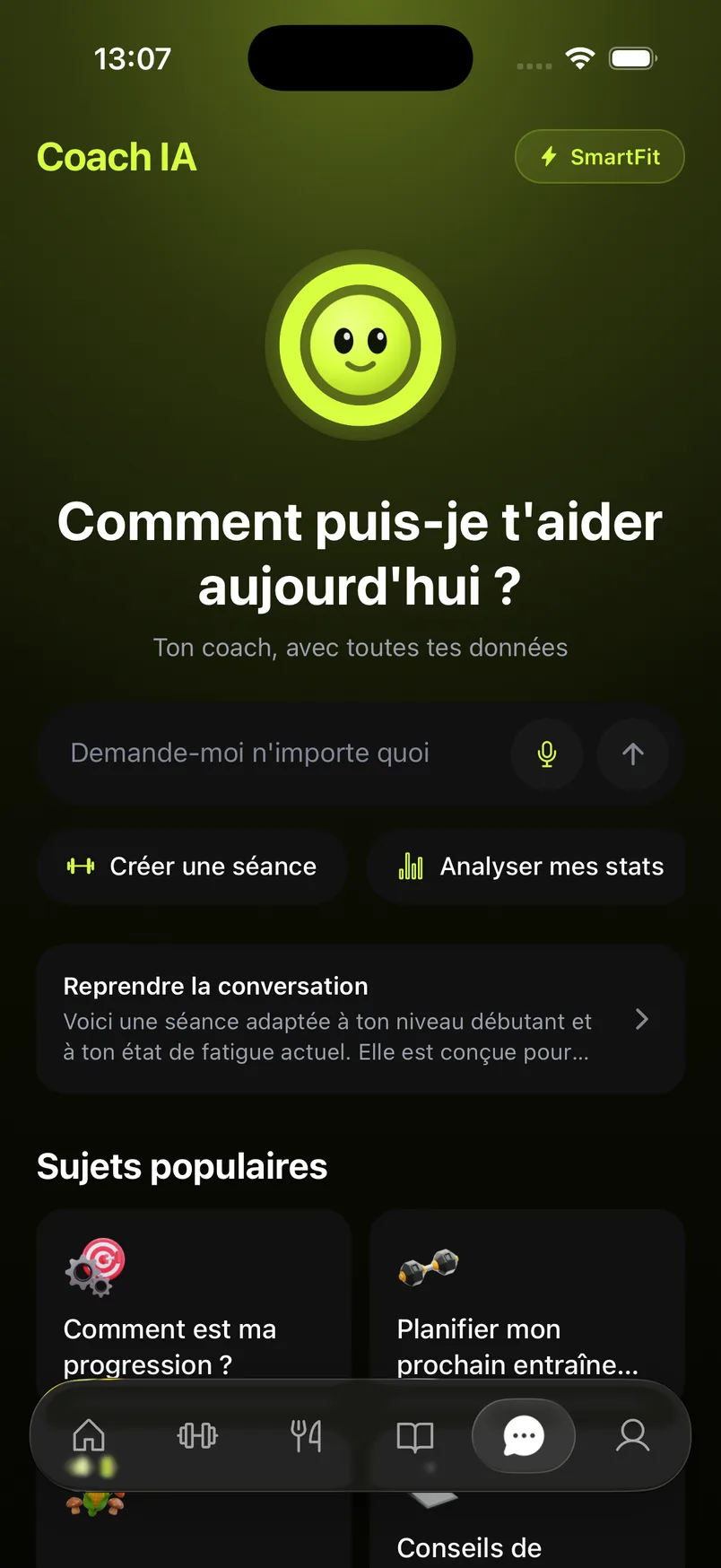
The mascot is
your progress.
The ring fills in over the course of your week — with no data, it stays open: we don’t claim what we don’t know.
Your question goes out with five blocks of real data, read fresh at that exact moment. That’s the difference between “do some core work” and “your squat hasn’t moved in three weeks.”
Age, height, weight, level, current goal, and the equipment you have access to.
What you actually did: exercises, sets, loads, dates. Not your planned program.

Your best performance for each exercise, and how long it’s been since it last moved.
Weight, waist, arms, thighs — with their trend, not just the latest value.

Where you stand on your water goal at the exact moment you ask.
When a piece of data shapes its answer, it shows up in the answer. You can check its reasoning instead of taking its word for it.
Its answer opens with a position, not a preamble. Detail, nuance, and conditions come after — never instead.
What you won’t read
“It depends on your goals, your level, and several other factors…”
An answer that won’t commit doesn’t help you decide what to do tonight. If the coach needs one more detail to give you a straight answer, it asks in a single sentence — it doesn’t hide behind one.
Plenty of assistants close every single question with “see a doctor.” That reflex protects no one — it’s a way of dodging. Here, the referral is reserved for four situations, and when it happens, it’s explicit.
Two ways to run the coach. Switch anytime, right from settings.
Nothing to configure, nothing to set up elsewhere. You open the conversation and write. The cost of the model is included in the subscription price.
Prefer to use your own Claude or ChatGPT account? Paste your key into settings and the coach uses it instead of the included engine. You stay in control of the model and the bill.

It doesn’t guess.
It has read your log.
Profile, records, measurements, today’s hydration — the context ships with the question, not after it.
Ask it for a workout and it hands you a real one: exercises, sets, reps, starting loads calibrated to your latest numbers. A button appears under its answer — tap it, and the workout starts in your log, already filled in.
No copy-pasting, no re-typing.
It’s not working from a plain list of names. For every exercise, it knows what’s being trained, how the movement is set up, and what it demands — so its substitutions actually hold up.
Typing between sets is a pain. Tap, talk, and your question is sent. Also handy when your hands are covered in chalk.

Your conversations stay put. You can find the program it gave you last month, and it keeps track of what’s already been said.

Every answer can be rated with one tap. It’s the most direct signal for fixing what the coach gets wrong — and during the closed beta, that’s exactly what we’re reading.
Three limits worth knowing before you find them out on your own.
It’s a training tool, not medical advice. For pain, a condition, or a treatment, the right answer is a healthcare professional — and it tells you so.
Your workouts, measurements, and conversations exist to answer you. They don’t feed the training of any model.
A workout you forgot to log doesn’t exist for it. It reasons from your log exactly as filled in, and says so when there isn’t enough to go on.
SmartFit AI is in closed beta on TestFlight. The AI coach is limited on the free plan and unlocks without limits with a subscription; your feedback goes straight into the next build.